
When the Bills Can’t Wait: Why Consumer Legal Funding Matters
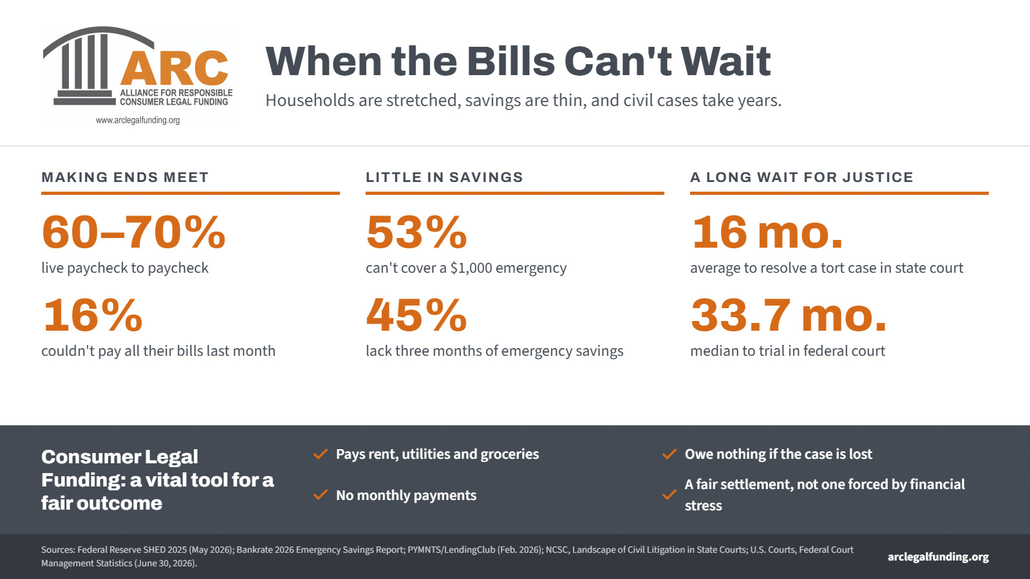
When someone is hurt through no fault of their own, the bills start arriving the next month. The case that may make them whole can take years. For a household with little or no savings, that gap is where the real damage is done, and it is the gap Consumer Legal Funding exists to fill.
The latest data on household finances and court timelines show how wide that gap has become. Most Americans can absorb a small surprise, but far fewer can absorb a lost paycheck, and a case can take anywhere from 16 months in state court to nearly three years in federal court.
Many households are one setback from falling behind
The Federal Reserve’s Survey of Household Economics and Decisionmaking (SHED), released in May 2026 and fielded in October 2025, found that 73% of adults say they are doing at least okay financially. Beneath that headline, the picture is more fragile:
- 16% of adults did not pay all their bills in full in the month before the survey. Among adults earning under $25,000, it was 34%.
- 26% went without some form of medical care in 2025 because they could not afford it, most often dental care and doctor visits.
- 59% faced at least one major unexpected expense in the prior 12 months, most commonly vehicle repairs, home repairs and unexpected medical bills.
- Financial well-being declined for young adults, lower-income households and Black adults, even as the overall figure held steady.
Private-sector trackers show the same strain. PYMNTS and LendingClub’s ongoing Paycheck-to-Paycheck series has found that roughly 60% to 70% of consumers have lived paycheck to paycheck from early 2024 through early 2026, with little sustained improvement. Inflation also rose again in spring 2026, reaching 3.3% in March after oil prices climbed.
For an injured worker, these numbers are not abstractions. An injury often means lost wages and new medical costs at the same time, hitting exactly the households least able to absorb either.
Savings are too thin to bridge a long case
The cushion most families would need to wait out a lawsuit simply is not there. The Fed’s own measures make the point:
- 37% of adults could not cover a $400 emergency with cash or its equivalent. The 63% who could is unchanged for four straight years and below the 2021 peak of 68%.
- Only 55% of adults have three months of emergency savings. That means nearly half could not cover a single quarter of lost income, let alone the years a case can take.
Bankrate’s 2026 Emergency Savings Report adds detail:
- 53% of Americans lack the savings or access to funds to cover a $1,000 emergency.
- 29% have more credit card debt than emergency savings, and another 19% have neither savings nor credit card debt.
- 58% say their emergency savings are the same or lower than a year earlier.
- Lower earners are hit hardest: only 12% of those earning under $40,000 have more savings than card debt, compared with 30% of those earning over $80,000.
The national personal saving rate tells the same story. After the Bureau of Economic Analysis’ annual revisions, it stood at about 4.1% of disposable income in August 2026, roughly half its long-run average near 8%.
Put simply, an injured consumer who misses even a few months of pay will, in many cases, exhaust savings long before a case is resolved.
Civil cases take a year and a half to three years
Whether a case is filed in state or federal court, the wait is long. Most personal injury claims are heard in state courts, where tort cases took an average of 16 months (486 days) to resolve, according to The Landscape of Civil Litigation in State Courts, the National Center for State Courts’ study of more than 925,000 civil cases in 10 urban counties. In federal court, the median civil case that went to trial took 33.7 months, nearly three years, in the 12 months ending June 30, 2026. Five years earlier it was 28.3 months.
The table sets the two court systems side by side. The figures measure different stages and come from different years, but they point the same way: a case that reaches trial takes two to three years, and in the slowest courts far longer.
| Court system | Measure | Time |
| State | Average time to resolve a tort case | 16 months |
| State | Average time to a jury verdict in a tort case | 26.5 months |
| Federal | Median time from filing to civil trial, national | 33.7 months |
| Federal | Median time to civil trial, slowest district (Eastern New York) | 57.1 months |
Sources: NCSC and IAALS, The Landscape of Civil Litigation in State Courts (2015); Bureau of Justice Statistics, Civil Bench and Jury Trials in State Courts, 2005; Administrative Office of the U.S. Courts, Federal Court Management Statistics, June 30, 2026.
Behind those figures are the cases that take longest. In state courts, 31% of tort cases were still unresolved after 18 months, while the courts’ own Model Time Standards call for just 2%. In federal court, more than 125,000 civil cases, 26% of the pending docket, were over three years old as of June 2026.
Most cases settle before trial, but the trial date sets the pace. Defendants and insurers know when a plaintiff is under financial pressure. The longer the wait, the stronger the incentive to hold out against someone who cannot afford to.
Where Consumer Legal Funding fits
Put the two data sets side by side and the need is plain. Nearly half of households lack three months of savings, while a case can take 16 months to nearly three years to resolve. Consumer Legal Funding bridges that gap.
It works differently from a loan. The consumer receives funds against a portion of a pending claim, and repayment comes only from the proceeds of the case. If there is no recovery, the consumer owes nothing. There are no monthly payments, no credit checks driving the decision and no personal liability if the case is lost.
That structure answers the specific problems the data reveal:
- Keeping the household afloat. Funds typically go to rent or mortgage payments, utilities, car payments and groceries, the same bills the Fed found one in six adults already struggling to pay.
- Avoiding worse options. Without it, many consumers would turn to credit cards, payday loans or high-cost installment debt, which require repayment regardless of how the case ends.
- Leveling the negotiating field. A consumer who can cover the basics does not have to accept an early, inadequate offer simply because the rent is due. The case can be resolved on its merits rather than on the plaintiff’s bank balance.
- Leaving the case in the attorney’s hands. The funding company does not control the litigation or settlement decisions; the consumer and counsel do.
Transparency matters too. Clear contracts that state the costs in plain dollars, a right to cancel and attorney acknowledgment protect consumers and the integrity of the product.
A vital tool for a fair outcome
These are difficult financial times for American families. Prices remain high, savings are thin, and millions of households are one missed paycheck away from falling behind. When an injury takes away a paycheck, the pressure arrives right away, while the case that could make the family whole moves on the courts’ schedule, not theirs.
That is why Consumer Legal Funding is a vital financial tool. It lets an injured consumer keep the lights on, pay the rent and put food on the table while the case runs its course. Because it is non-recourse, the consumer owes nothing if the case is lost. They are not trading one financial crisis for another.
Most importantly, it protects the value of the claim itself. A consumer facing eviction or mounting bills may feel they have no choice but to accept the first offer, even when it falls far short of what the case is worth. Consumer Legal Funding removes that pressure. It gives consumers the time to reach a fair and just settlement, one based on the facts of their case rather than one forced on them by financial stress.
Sources
- Federal Reserve, Economic Well-Being of U.S. Households in 2025: Economic Hardships
- American Banker, Fed survey: Americans feel financially secure despite prices
- InvestmentNews, Fed survey reveals cracks beneath stable surface of US financial health
- Financer, Emergency Fund Statistics 2026 (citing Fed SHED 2025)
- Bankrate, 2026 Annual Emergency Savings Report
- Bankrate press release, February 4, 2026
- Pulse, Bankrate report summary
- PYMNTS, The Paycheck-to-Paycheck Report, February 2026
- The Independent via Newswav, paycheck-to-paycheck and inflation
- Axis Intelligence, Savings Rate Statistics 2026 (BEA data)
- NCSC and IAALS, The Landscape of Civil Litigation in State Courts (2015)
- NCSC, Assessing the Landscape of Civil Litigation in State Courts
- NCSC, Model Time Standards for State Trial Courts
- Bureau of Justice Statistics, Civil Bench and Jury Trials in State Courts, 2005
Administrative Office of the U.S. Courts, Federal Court Management Statistics, June 30, 2026
