
Congress Must Protect Consumers When Reforming Litigation Financing Tax Laws
In an October 13 National Review article, David Malpass and James Carter argue that Congress should close tax loopholes benefiting foreign investors who finance lawsuits against American companies. Their concerns about commercial litigation financing and preferential tax treatment deserve consideration.
However, as Congress considers the Tackling Predatory Litigation Funding Act, lawmakers must recognize a critical distinction: Consumer Legal Funding is not commercial litigation financing, and qualifying consumer transactions must be expressly excluded from the proposed federal tax provisions.
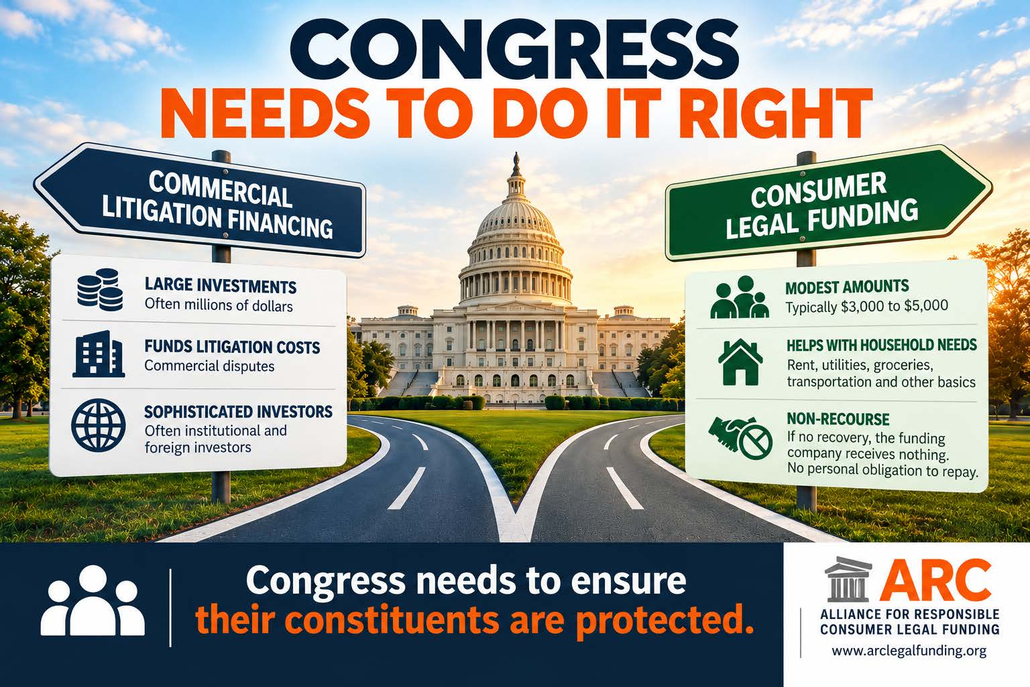
Commercial litigation financing typically involves substantial investments to finance litigation expenses, often involving millions of dollars. Consumer Legal Funding serves an entirely different purpose.
Consumer Legal Funding provides individuals with pending legal claims modest amounts of financial assistance, typically $3,000 to $5,000, to cover essential household expenses such as rent, utilities, groceries, and transportation.
These funds are not used to finance lawsuits, pay attorneys, or cover litigation expenses.
Consumer Legal Funding is also non-recourse. If the consumer receives no recovery from their legal claim, the funding company receives nothing. The consumer has no personal obligation to repay the funds.
For individuals facing financial hardship while awaiting resolution of their legal claims, this assistance can be essential. Without it, consumers may feel pressured to accept inadequate settlements simply to meet immediate financial obligations.
Congress must ensure that legislation targeting commercial litigation investors does not inadvertently restrict financial assistance to American consumers.
Simply acknowledging that Consumer Legal Funding differs from commercial litigation financing is insufficient. Without an explicit statutory exclusion, broad legislative definitions could subject small-dollar consumer transactions to the same specialized tax and withholding requirements intended for sophisticated commercial investors.
The consequences could include increased compliance costs, higher consumer charges, reduced funding availability, and fewer financial options for individuals already experiencing economic hardship.
Congress should therefore expressly exclude non-recourse Consumer Legal Funding transactions where funds are provided directly to individuals for personal, family, or household expenses and are not used to finance litigation or legal costs.
Such an exclusion would not exempt funding companies from generally applicable federal taxes. It would simply ensure that legislation targeting commercial litigation financing does not unintentionally encompass an entirely different consumer financial product.
Numerous states have already recognized Consumer Legal Funding as a distinct financial transaction and established appropriate regulatory safeguards. Congress should recognize that same distinction.
The difference between financing litigation and helping consumers survive financially while litigation is pending is fundamental.
Congress can address legitimate tax concerns involving foreign litigation investors without harming American consumers.
But that protection cannot be left to regulatory interpretation or future litigation.
It must be expressly written into federal law.
Consumer Legal Funding: Funding Lives, Not Litigation.
